

How to Avoid Tourist Traps in Lisbon
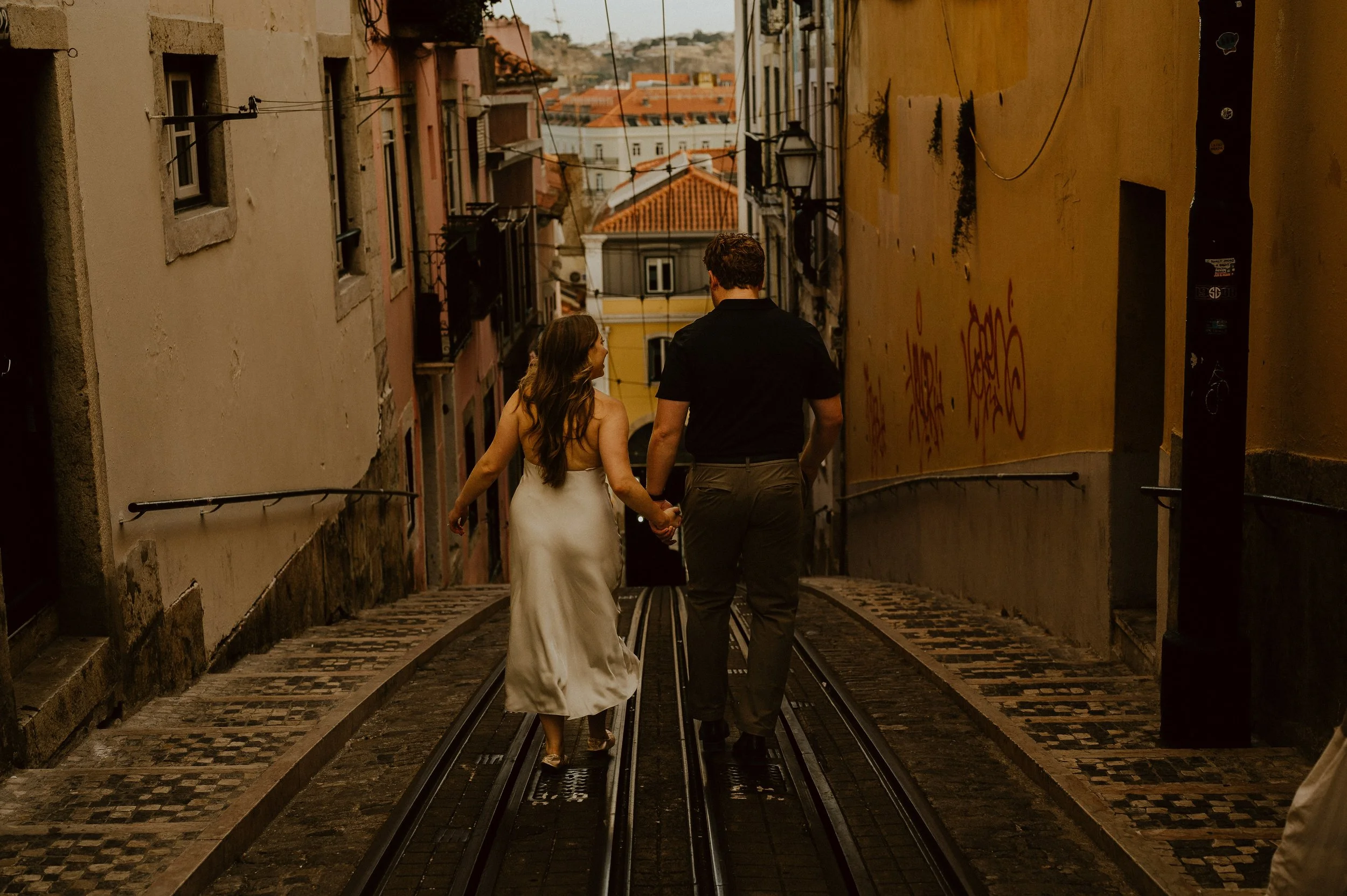
Book your own immersive romantic photo experience in Lisbon with a local [link]
Introduction
The quick answer:
To avoid tourist traps in Lisbon, look for restaurants without photos on the menu, prices in one language only, and locals eating there past 8pm. Walk two streets back from any major square or viewpoint before deciding where to eat. Skip anything with a person outside inviting you in. And be honest that "authentic" is a word that's been drained of meaning so what you actually want is specificity, not a performance of it.
Before we dive into more detail, I’d like you to join me in a quick reflection about “authenticity” and the word itself, because I surely have opinions about it and this is one of them.
"Authentic" gets used so much in travel writing that it's stopped meaning anything. Every restaurant claims it, every walking tour promises it. A place that charges you triple for a plate of bacalhau will still call itself "an authentic taste of Lisbon" on the sign out front, and the sign will be in five languages, which is your first clue that something's off. The word has become a marketing tool for exactly the thing it's supposed to help you avoid.
So instead of chasing "authentic," here's a more useful question: is this place built for the people who live here, or for the people passing through? Because if you chase real authentic you’re looking to live a city as a local, not as a mere tourist wanting to experience Lisbon the same way you’ve experienced Paris. If this is not what you’re actually looking for, then I’m afraid this article won’t be for you.
The menu tells you almost everything
Open the menu before you sit down. If it has photos of the food, laminated pages, and a "tourist menu" printed in four languages, you're not in a bad restaurant necessarily, but you are in one built to process volume rather than serve a neighborhood. Real neighborhood tascas usually have a menu in Portuguese, maybe a handwritten daily special on a chalkboard, and a waiter who'll happily translate if you ask. That friction is actually a feature, not a flaw or inconvenience to be avoided. It means the place wasn't designed around your convenience which tells you that it probably is as authentic as it can get.
Prices matter too, but not in the way you'd think. A tourist trap doesn't always mean expensive ( some of them are cheap and terrible, cutting corners on ingredients while charging fair prices, banking on volume and one-time visitors who'll never come back to complain). Consistency is a way better signal. If a bacalhau à brás costs 12 to 15€ at three places in a row and then 25€ at the one with the accordion player stationed outside, that gap is the tell, not the price itself.
Some golden rules to check the authenticity of a place:
if a “fado restaurant” features dishes like paella, burgers, kebabs or pizzas too, that’s how you know that that place is not authentically portuguese;
if a “chourizo assado” costs you more than 7€ or a single desert is priced above 5€ then it’s a tourist trap with inflated prices that locals would never accept to pay.
Timing says more than the sign does
Lisbon eats late. Locals typically don't sit down for dinner before 8pm, often later. It’s not that we don’t want to eat earlier, but between finishing work at 5-6pm and picking up the kids from school whilst facing traffic for an hour or more, having dinner before 8pm is not really possible so if a restaurant is packed at 6:30pm, you're eating with other visitors, which isn't a crime, but it does mean you should adjust your expectations about who the food is actually made for. Watch who's inside. If it's mostly people your age carrying day bags and cameras, that's not damning on its own, after all, everyone's a tourist somewhere, but combined with the menu tell above, it starts to build a picture.
The same logic applies to viewpoints. Miradouro de Santa Luzia at golden hour is stunning and also completely full of the exact experience you're trying to avoid: vendors selling overpriced sangria in plastic cups, a slow shuffle of people all taking the same photo. Go an hour earlier or later, or walk ten minutes further to Miradouro da Senhora do Monte instead, and you get most of the same view with almost none of the performance around it.
This article might interest you:
Anyone standing outside inviting you in, don't go in
This one's close to universal, not just in Lisbon. A restaurant confident in what it's doing does not need a person on the sidewalk with a laminated menu, waving you over like you're a passing car they need to flag down. The places locals actually love don't advertise on the street because they don't need new customers when they already have regulars.
Same goes for fado. A dinner-and-show package with a fixed menu and a cover charge, advertised on a sandwich board outside, is built for a one-night audience. The real thing happens in small tascas after dinner service winds down, unannounced, when someone who's been coming for years picks up a guitar because the mood is just right. You can't book that because there’s no real way to predict it. You can only be somewhere long enough, or ask the right person, to stumble into it.
Ask, but ask the right people
If you're reading this, you already know how to ask a good questions, it’s already built-in in you and I know that because only a critical thinker would actively search for real authentic experiences rather than the tourist traps everyone falls into. So I’ll ask you to use that instinct here. Don't ask "what's a good restaurant" to a hotel concierge who gets a commission for the answer. Instead, ask a shop owner, a bartender at a quiet place you already trust, someone at the flat you're renting. Ask them where they'd take their own visiting family, not where they'd send a stranger. The phrasing has the power to change the answer.
And when someone gives you a name, notice how they say it. If they light up a little, if there's a story attached ("my grandmother used to go there," "it's run by the same family since the seventies"), that's worth more than any five-star rating. Reviews online are aggregated opinions from strangers who mostly ate there once and never returned but a specific, personal recommendation from someone who actually lives in the city is a completely different category of information.
It's fine to do the touristy thing sometimes
None of this means you must avoid the famous places on principle. Jerónimos Monastery is genuinely worth seeing, pastéis de Belém, despite the queue, is worth the queue at least once. The point was never to be precious about avoiding anything popular but simply to notice when a place has stopped being for the city and started being only for you, the occasional visitor, and to decide with open eyes and critical thinking whether that trade-off is one you're willing to make. Sometimes it is, other times the view is worth the crowd. Just know which one you're choosing, and don't mistake a well-marketed experience for a meaningful one or in the end you might return home feeling disappointed and with the sensation that you haven’t quite experienced the place at all.
This is, honestly, the same instinct behind the kind of romantic experiences I design here in Lisbon. Not a staged photo op in front of a landmark everyone's seen a thousand times, but time built around the two of you specifically: a walk through a neighborhood chosen for how it fits your actual personalities, conversation prompts instead of forced poses, a route that has nothing to do with what's trending and everything to do with what you told me you value. The photos end up being proof it happened, not the reason you did it. If that's the kind of afternoon with a local you're after while you're here, you can read more about it here.

FAQ
-
Check the menu before sitting down. Photos of food, translated prices, and a tout outside inviting people in are all signs the restaurant is built for volume and turnover rather than for a neighborhood clientele.
A consistent price for the same dish across nearby places, versus one outlier charging double, is another useful signal, however, if you are in a 100% touristic area chances are all restaurants will offer you the same price-range so try to move 2 or 3 streets away from the most known ones to verify if there is a contrast (there are areas where this will be impossible. For example: the entire Bairro Alto area is full of tourist traps so you won’t be able to compare a true local experience with a tourist-only offer because there will only be the later, in every street)
-
No. Some famous sights, like Jerónimos Monastery or the view from Miradouro de Santa Luzia, are worth experiencing even with the crowds. The goal isn't to avoid everything popular, just to be aware of which experiences are genuinely worth the trade-off and which ones are simply well-marketed.
-
Not at all, most people are happy to share a favourite spot if you ask sincerely. Ask people who live in the neighborhood, like a shop owner or bartender, rather than someone whose job involves a referral commission, and ask where they'd take their own family rather than a stranger. This will help you filter your options.
-
Typically 8pm or later. Restaurants that are full by 6:30pm are more likely to be catering to visitors adjusting to an earlier home-country dinner schedule.
-
The bigger risk is usually overpaying for a mediocre, mass-produced experience rather than outright scams, though pickpocketing on crowded trams like the 28 is a known issue worth staying alert to. Keep bags zipped and in front of you in tourist-dense areas.
In short, avoiding tourist traps in Lisbon isn't about finding some secret list of hidden gems but rather about reading small signals (the menu, the timing, who's actually eating there, who's asking you in versus who doesn't need to) and choosing, deliberately, whether an experience is built for the city or built for you as a visitor passing through.
With love,
Patricia, your romantic high-intentional experiences designer and photographer
Related Articles


About the Author:
Patricia Nunes is a couples photographer, experiences designer and the creator of the "Intentional" newsletter. She specializes in helping discerning couples build more intentional lives and relationships, using expertly guided photography experiences as a powerful tool to facilitate profound connection.
Lisbon, London and beyond.

A local’s honest picks for the best day trips from Lisbon, plus the neighborhoods inside the city everyone tends to skip.